

Jakarta, 25 November 2026 – PT Humpuss Maritim Internasional Tbk (IDX: HUMI) has allocated capital expenditure (CAPEX) of US$170 million for 2027. The funds will go toward expanding its fleet and developing liquefied natural gas (LNG) infrastructure. With this expansion, the Company is targeting 2027 revenue of US$174 million, up 30% year on year, and net profit of US$8.39 million.
Management presented the plan at the 2026 Public Expose, held online on Wednesday (25/11). As of September 2026, HUMI recorded operating revenue of US$102.54 million, up 6.3% from US$96.48 million in the same period last year. The vessel chartering segment was the main contributor, accounting for 98.1% of total revenue, mainly from oil and oil & chemical transportation.
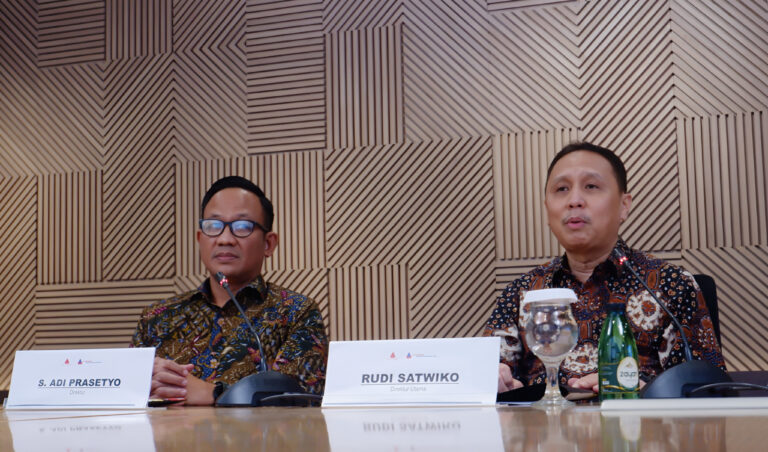
“For us, a successful investment is not measured only by the size of capital expenditure or the number of assets owned. What matters more is how those assets deliver productivity, generate revenue and create added value for the Company,” said Rudi Satwiko, President Director of HUMI.
The 2027 CAPEX will fund eight additional vessels: three tug assist vessels, two oil tankers, one oil & chemical tanker and two gas carriers. Funds are also allocated to building a mini LNG plant, converting an LNG carrier into a floating storage and regasification facility (FSU/FSRU), and establishing the Humpuss Maritime Simulator Centre. The Company projects net fixed assets to rise by about 40% compared with the 2026 forecast.
This expansion continues the fleet growth of the past two years. The number of vessels owned and operated by HUMI rose from 47 in 2024 to 53 in 2025, and is targeted to reach 61 by the end of 2026. This year, the Company budgeted US$50.6 million to acquire 10 vessels, including oil tankers, oil & chemical tankers, tugboats and a crane barge, of which 8 have been delivered.
Entering the LNG Infrastructure Business
Several prospective offtakers for the Mini LNG Plant project have reached the Heads of Agreement (HoA) stage. The project is targeted to come on stream in the fourth quarter of 2027.
HUMI is also developing an FSU/FSRU facility in the Bali area. CAPEX will be spent in phases as the project progresses, and construction of the FSU/FSRU is expected to take around 9–12 months.
“Developing the Mini LNG Plant and the FSU/FSRU is part of HUMI’s strategy to expand its energy infrastructure business. We are optimistic that both projects will open up growth opportunities and become new sources of revenue for the Company going forward,” said Rudi Satwiko, President Director of HUMI.
Focus on Earnings Quality
As of September 2026, HUMI recorded EBITDA of US$29.52 million, a 28.79% margin, and net profit of US$3.55 million. Net profit was affected by amortization of LNG vessel docking costs and vessel fuel (bunker) costs. The Company’s total assets rose 6% year on year to US$343.29 million.
“Investing in our fleet and operating assets does affect our cost structure, but it also strengthens HUMI’s capacity to capture larger business opportunities. Our focus is not only on growing revenue, but also on fleet utilization, operational efficiency and cost control,” said Adi Prasetyo, Director of HUMI.
To boost 2027 earnings, the Company will maintain fleet utilization, secure more long-term contracts to reduce its reliance on the spot market, develop its LNG business and tighten cost efficiency. It will also keep improving the digitalization of its vessel management systems.
“We see 2027 as an opportunity to strengthen our business fundamentals while improving profitability. HUMI’s growth does not depend on a single segment, but is supported by an increasingly diversified portfolio,” said Adi.
On sustainability, HUMI ranked third among 10 transportation and logistics companies in the 2026 KESGI Assessment by Katadata Green, with an ESG score of 55.3. Throughout 2025, the Company recorded zero oil spills and zero lost time incidents, and 64% of its fleet now uses more environmentally friendly fuel.
For more information, please contact: corpsec@humi.co.id.